
Multi-Agent or Single Agent: Which Fits Your Workflow?
Impleko AI · 9 min read
Start with one well-scoped AI agent. Add more only when tasks need separate tools, parallel work, or independent checks. Here is how to decide, with real examples.
Key Takeaways
- Start with one well-scoped AI agent. It is easier to build, cheaper to run, and simpler to debug than a team of agents, and it handles most business workflows.
- Move to multiple agents only when a workflow has clearly separate jobs that need different tools, different permissions, parallel work, or an independent checker.
- Multi-agent systems cost more. Anthropic reported that its multi-agent research system used about 15 times more tokens than a standard chat.
- If the steps never change, a plain rule in n8n, Make, or Zapier beats any agent. Use AI only where the input is messy or the decision needs judgment.
- Prove the workflow with a single agent and a human in the loop first. Split it into several agents only when logged failures show a single agent cannot cope.
What is the difference between a single AI agent and a multi-agent system?
A single AI agent is one language model (such as Claude or an OpenAI model) given one goal, a set of tools, and instructions, which decides its own next step until the job is done. A multi-agent system is several such agents, each with its own role and tools, passing work between them or reporting to a coordinating agent.
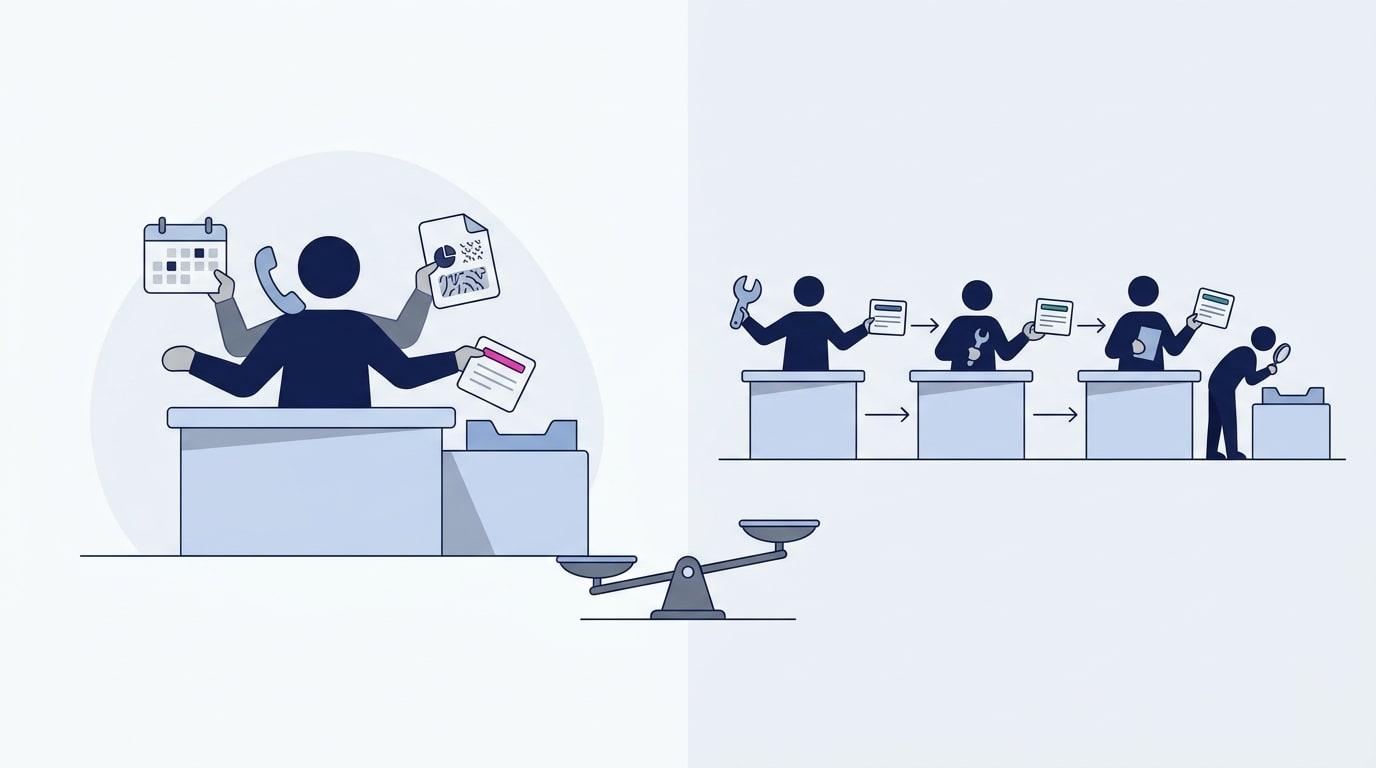
Think of a front desk. A single agent is one capable receptionist who answers calls, checks the calendar, and books the appointment. A multi-agent system is a small department: one person triages, another handles billing, a third reviews the output before it goes out.
Both are built from the same parts: a model, a prompt, tools (calendar, CRM, email, WhatsApp Business API), and memory. The difference is how many decision-makers you wire together and how they share context.
When is one well-scoped AI agent enough?
One agent is enough when the workflow has a single goal, a small toolset, and one shared context. Appointment scheduling, lead qualification, support ticket deflection from a knowledge base, and most inbound AI voice agent calls fit this pattern.
A good test: can you describe the job in one paragraph and list the tools in under a handful of lines? If yes, one agent should do it.
Say a dental clinic wants every missed call answered. A voice agent built on Retell AI or VAPI, connected to Twilio and the clinic calendar, can greet the caller, collect details, check availability, and book the slot. Everything it needs sits in one conversation, so splitting it into three agents would only add handoffs where information can get lost. Impleko AI would typically scope a build like this as a single agent.
Anthropic's guide to building effective agents makes the same point: find the simplest solution that works and add complexity only when it clearly improves results.
When does a workflow justify a multi-agent system?
A workflow justifies multiple agents when single-agent attempts fail for a specific, observable reason: the instructions have grown too long, the toolset is too large to choose from reliably, the work can run in parallel, or a task needs an independent reviewer. Without one of those reasons, extra agents add cost without adding quality.
Four situations usually qualify:
- Separate permissions. An agent that reads customer records should not also have the power to issue refunds. Splitting roles lets you give each agent only the access it needs.
- Parallel breadth. Research or data gathering across many sources can be split so several agents work at once. Anthropic reported that a multi-agent setup (a lead Claude Opus 4 agent with Claude Sonnet 4 subagents) beat a single Opus 4 agent by 90.2% on its internal research evaluation, a task that is broad and parallel by nature.
- Independent checking. A second agent that reviews the first agent's output, such as a contract summary or a compliance message, catches errors the author agent tends to repeat.
- Different specializations. When one step needs document data extraction and another needs persuasive writing, separate prompts and even separate models can perform better than one overloaded prompt.
What does a multi-agent system cost compared with one agent?
A multi-agent system costs noticeably more to run, build, and maintain than one agent. Every agent makes its own model calls, and agents spend tokens briefing each other, so usage multiplies quickly.
In the same research write-up, Anthropic stated that its multi-agent system used about 15 times more tokens than chats, and that such systems only pay off when the value of the task is high enough to cover the extra spend. For a $20 lead that needs a two-line text, that math rarely works. For a high-value research or underwriting task, it can.
Build and maintenance costs rise too. More agents mean more prompts to test, more handoffs to log, and more places for a failure to hide.
Why do multi-agent systems fail more often?
Multi-agent systems fail mainly because agents do not share full context. One agent makes a decision based on part of the picture, another makes a conflicting decision based on a different part, and the combined result does not fit together.
Cognition, the team behind the Devin coding agent, argues this in its post "Don't Build Multi-Agents" on cognition.ai, recommending that context be shared fully and that actions carry implicit decisions that conflict when split across agents.
In business terms, imagine a lead follow-up system where one agent writes the text message and another books the meeting. If the writer promises a Saturday slot and the scheduler only sees weekdays, the lead gets a confusing experience. One agent holding both jobs would not make that mistake.
Single agent vs multi-agent: how do they compare?
A single agent wins on simplicity, cost, and debuggability. Multiple agents win on parallelism, separation of permissions, and independent review. The table summarizes the trade-offs for a typical business workflow.
| Factor | Single agent | Multi-agent system |
|---|---|---|
| Best for | One goal, one shared context | Distinct roles, parallel or reviewed work |
| Build time | Days to a couple of weeks | Longer, with more testing |
| Running cost | Lower | Higher (more model calls and tokens) |
| Debugging | One log to read | Many handoffs to trace |
| Main risk | Overloaded prompt or too many tools | Lost context between agents |
| Typical examples | Voice receptionist, support bot, lead qualification | Research pipelines, drafting plus compliance review, large document processing |
Do you even need an AI agent, or is a plain workflow better?
If the steps are fixed and the inputs are predictable, a rule-based workflow is better than any agent. A form submission that creates a CRM record and sends a confirmation email needs a trigger and two actions, not a language model.
Tools like n8n, Make, Zapier, and GoHighLevel automation handle that kind of work cheaply and predictably. Bring in an LLM only at the steps where the input is messy: reading a free-text inquiry, classifying intent, or pulling fields out of a scanned document.
A common and sound design is a fixed workflow with one AI step inside it. The workflow controls the order of operations, and the model handles only the part that needs language understanding. You get reliability from the rules and flexibility from the model.
How do you decide which design your workflow needs?
Decide by working through four questions in order: can a fixed rule do it, can one agent do it, where exactly does one agent fail, and is the value of the task high enough to pay for more agents. Stop at the first "yes" you can defend. Impleko AI uses these same questions when scoping a client workflow.
- Are the steps fixed? Build a rule-based flow in n8n, Make, or Zapier.
- Is the goal single and the context shared? Build one agent with a tight prompt and a small set of tools. Add retrieval augmented generation if it needs to answer from your documents.
- Did the single agent fail in a logged, repeatable way? Name the failure: too many tools, conflicting instructions, no independent check, or work that should run in parallel.
- Does the task value justify the extra spend? If so, split only the part that failed into a second agent, rather than rebuilding everything as a team.
This approach grows a system from evidence instead of from a diagram.
How should you start building without overspending?
Start with a proof of concept that uses one agent, real data, and a human in the loop for anything high-stakes. Run it on real calls, chats, or documents, read the logs, and let the failures tell you whether a second agent is needed.
For example, a real estate team might begin with a single AI sales agent that responds to new leads within a minute, a classic speed to lead fix, and asks three qualifying questions before booking a viewing. If logs show the agent struggles to both qualify and handle detailed property questions, that is a concrete reason to add a second knowledge-base agent. Before that evidence exists, it is a guess.
Impleko AI follows this sequence when scoping agent projects: map the workflow, ship the smallest working version, and add agents only where the logs justify them.
Frequently Asked Questions
What is the main difference between a single AI agent and a multi-agent system?
A single agent is one model with one goal and a set of tools. A multi-agent system uses several agents with separate roles that hand work to each other or to a coordinator.
Is a multi-agent system more accurate than a single agent?
Not by default. It can be more accurate on broad, parallel tasks like research, but it can also be less reliable when agents lose shared context. Accuracy depends on the task and how well the handoffs are designed.
When should I use a multi-agent system for my business workflow?
Use one when a single agent has failed in a repeatable way and the fix is separate permissions, parallel work, independent review, or distinct specializations. The task should also be valuable enough to cover higher running costs.
Are multi-agent systems more expensive to run?
Yes. Each agent makes its own model calls and agents spend tokens briefing each other, so usage rises. Anthropic reported about 15 times more tokens than a standard chat for its multi-agent research system.
Can I start with one agent and add more later?
Yes, and it is the recommended path. Ship a single well-scoped agent, log its failures, and split off a second agent only for the specific part that needs it.
Do I need an AI agent at all, or is Zapier or n8n enough?
If the steps are fixed and the inputs are predictable, n8n, Make, or Zapier is enough and is cheaper and more predictable. Add an AI step only where the input is unstructured or the decision needs judgment.