How do Vapi and Elevenlabs differ from each other?
How do Vapi and ElevenLabs differ from each other?
When it comes to AI voice technology, are you looking for a voice that sounds perfectly human or one that can actually think and respond? In AI voice technology, these are two very different approaches. Some platforms focus on creating human-sounding voices, while others are designed to manage full conversations, acting as the brain behind interactive experiences
Two of the leading platforms in this space are ElevenLabs and Vapi. While both are central to modern voice AI, they excel at different, though related, tasks. This article will clarify what each platform does, who it's designed for, and how they can even work together to create voice applications.
1. The Core Difference Between The Voice Actor vs. The Director
The simplest way to understand the distinction between ElevenLabs and Vapi is through an analogy from filmmaking.
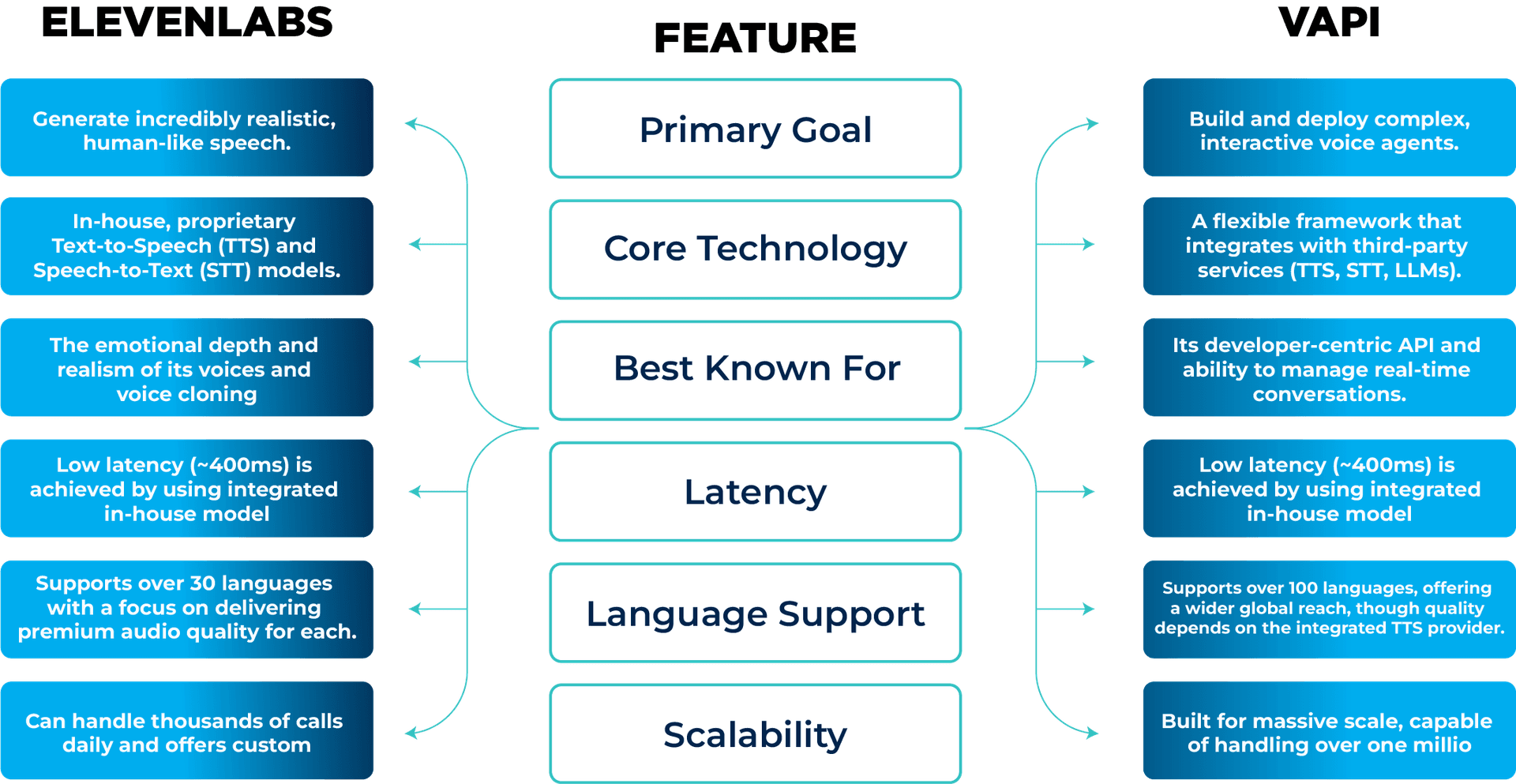
ElevenLabs (The Voice Actor): Think of ElevenLabs as a specialist actor, singularly focused on the craft of voice. Its primary job is to create the highest-quality, most realistic, and emotionally expressive AI speech possible.
It is widely considered the "gold standard" for voice quality, a reputation built on its powerful, in-house Text-to-Speech (TTS) models that capture nuances like intonation and emotion, as well as advanced features like precise voice cloning.
Vapi (The Director & Film Crew): Vapi, on the other hand, is the director and the entire production crew. It acts as an "orchestration layer," managing the whole conversational scene.
Its job isn't to create the voice but to direct the flow of conversation, like handling interruptions gracefully, performing complex backend actions like booking an appointment or fetching data via API calls, and integrating with other business systems like CRMs. As a developer-first platform, Vapi can "hire" a voice actor, like ElevenLabs, to deliver the lines it directs.
2. Detailed Feature and Capability Comparison
This table provides a side-by-side comparison of the most critical features to help you understand their distinct roles.
3. Who Is Each Platform For?
The ideal user for ElevenLabs is very different from the ideal user for Vapi.
ElevenLabs Users for Creators Who Need the Perfect Voice
ElevenLabs is the go-to choice when the quality, realism, and emotional depth of the voice are the top priority. It is designed for users who need the final audio output to be the star of the show.
Ideal Use Cases:
- Content creators producing podcasts or YouTube videos.
- Publishers are developing lifelike narration for audiobooks.
- Game developers are designing characters with unique, expressive voices.
- Educators are creating engaging and high-fidelity learning content.
Vapi Users for Developers Building Conversational Experiences
Vapi is designed for engineering-driven teams who need a robust framework that offers deep control and customization to build, deploy, and scale interactive voice applications. The focus is on the conversational logic and backend integration, not just the voice.
Ideal Use Cases:
- Automated customer support phone lines that can handle complex inquiries.
- Intelligent AI agents for scheduling appointments or managing bookings.
- Scalable outbound sales calls to qualify leads or follow up with customers.
- Complex voicebots that need to connect to external databases or APIs in real time.
While their target audiences are distinct, you don't always have to choose one over the other.
4. A Quick Look at Pricing
The pricing models for ElevenLabs and Vapi are designed around their core users. ElevenLabs primarily offers subscription-based tiers, where costs are often tied to the number of characters or minutes of audio you generate each month.
ElevenLabs Pricing
ElevenLabs utilizes a tiered subscription model, with costs generally based on the number of characters or minutes of audio generated. Unused credits do not roll over month-to-month on some plans.
Vapi Pricing
Vapi, on the other hand, uses a per-minute, usage-based model designed for developers. This means you pay for what you use, which is suitable for applications where call volume may fluctuate. This model may also include pass-through costs for any third-party services you choose to integrate.
• Pay-As-You-Go: Starts at $0.05 per minute for calls.
• Phone Numbers: $2 per month per phone number (U.S. or Canadian).
• Provider Costs: Costs for third-party transcription, LLM, and voice services are billed at cost, or developers can bring their own API keys.
• Free Tier: Offers $10 in free credits to start.
• Enterprise: Custom pricing with volume discounts and dedicated support is available.
While they seem like competitors, these two platforms don't have to be an "either/or" choice.
5. Testing with a Scenario
The choice between ElevenLabs and Vapi is not always an "either/or" decision. In fact, one of the most powerful approaches is to use them together.
Imagine building an AI agent to handle customer support for an airline. You could use Vapi to manage the conversational flow, understanding when a customer wants to "check a flight status" versus "book a new flight" and connecting to the airline's booking system via an API.
Then, instead of using a generic voice, Vapi would hand off the lines to ElevenLabs to deliver the responses with a calm, professional, and incredibly realistic voice, enhancing the customer's experience. This combination creates a voice agent that is not only responsive and scalable but also speaks with the human-like quality that ElevenLabs is famous for.
6. A Collaborative Future for Voice AI
The comparison between ElevenLabs and Vapi is not always an "either/or" decision. The most powerful approach often involves combining them with using Vapi as the scalable framework to manage conversational logic and integrations, while using ElevenLabs as the integrated TTS engine to deliver its world-class, human-like voice.
Ultimately, the choice depends entirely on the project's core requirements:
• Choose ElevenLabs when the primary goal is to generate the highest quality, most realistic AI voice audio for applications where the voice itself is the central feature.
• Choose Vapi when the primary goal is to build, deploy, and scale a complex, interactive, and highly customized conversational AI agent that can perform specific business tasks.