
AI SDR vs Human SDR: What Startups Actually Pay and Get
Impleko AI · 10 min read
Compare AI sales agents and human SDRs on cost, speed, and conversion, with a worked cost example and a clear rule for when a startup should use each of them.
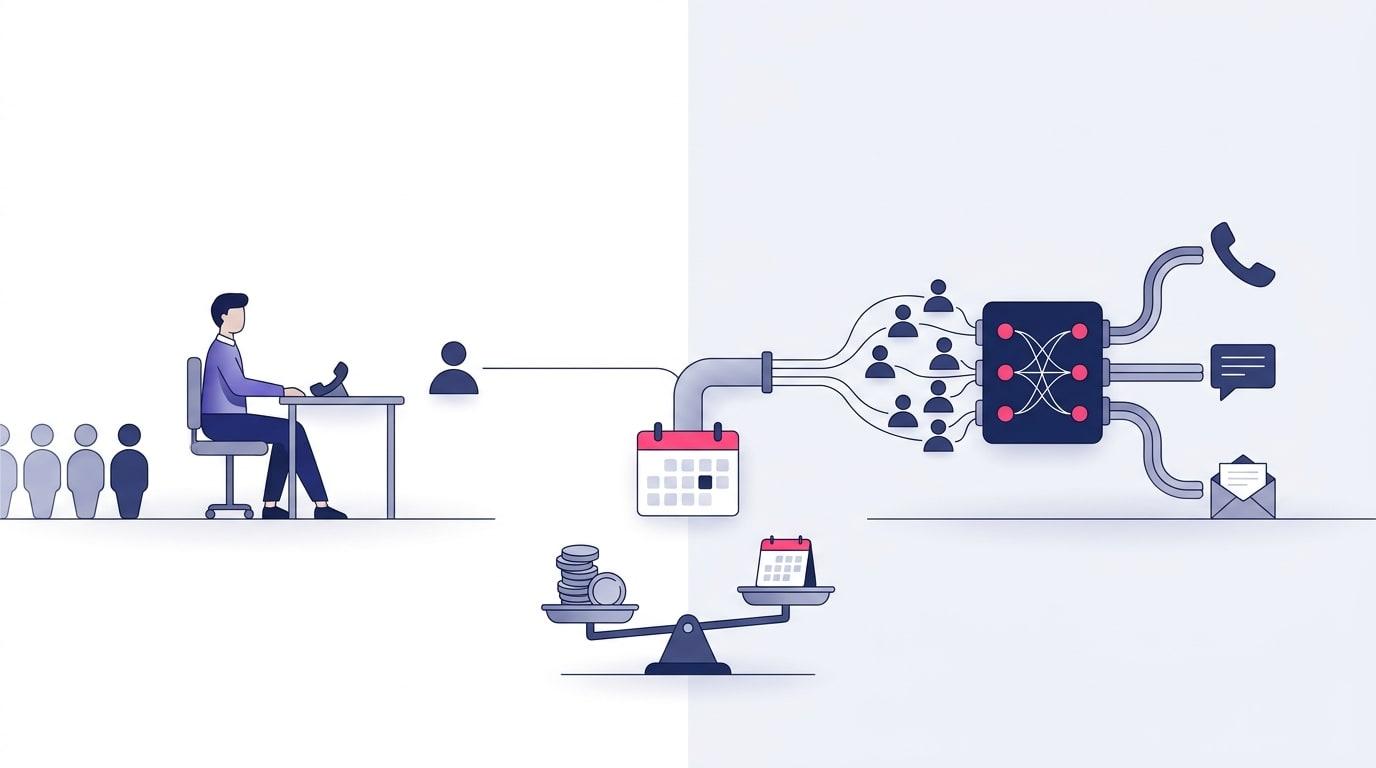
Key Takeaways
- An AI sales agent wins on speed, coverage, and cost per touch. A human SDR wins on judgment, complex conversations, and trust with high-value buyers.
- Speed matters more than most teams assume. Research published in Harvard Business Review found that firms contacting a lead within an hour were nearly seven times as likely to qualify that lead as firms that waited longer.
- Most startups should not choose one or the other. The practical setup is an AI agent that handles instant follow-up, lead qualification, and appointment scheduling, with a human closing the meeting.
- A plain rule often beats AI. If a task is "send this email when a form is submitted," a workflow in n8n, Make, or Zapier is cheaper and more reliable than an AI agent.
- Cost per booked meeting, show rate, and pipeline created are the numbers to compare, not seats or messages sent.
What is an AI sales agent, and how is it different from a human SDR?
An AI sales agent (often called an AI SDR) is software that contacts, qualifies, and books leads over email, chat, SMS, WhatsApp, or voice, using a large language model such as Claude or OpenAI's models plus your CRM data. A human SDR (sales development representative) does the same job manually, one conversation at a time.
The difference is not intelligence, it is capacity and consistency. An AI agent answers at 2 a.m., never forgets a follow-up, and handles hundreds of conversations at once. A human SDR reads tone, handles odd objections, and knows when to stop pushing.
In practice, the AI agent is a system, not a single tool. A typical build connects a voice layer (Retell AI or VAPI with Twilio), a messaging layer (WhatsApp Business API, SMS, email), a CRM such as GoHighLevel, and an orchestration layer (n8n, Make, or Zapier) that moves data between them. Impleko AI builds and connects these layers for startups so they work as one system.
How much does an AI SDR cost compared with a human SDR?
A human SDR is mostly a fixed salary plus benefits, tools, management time, and ramp-up. An AI sales agent is mostly build cost plus a monthly run cost for software, telephony, model usage, and some human review. The AI side is usually cheaper per conversation, but not free.
Here is an illustrative example, not real benchmark data. Say a startup pays a human SDR $90,000 a year fully loaded, or $7,500 a month, and that SDR books 12 qualified meetings a month. That is about $625 per meeting. Now say an AI setup costs $2,500 a month all in (tools, calling minutes, model usage, and a few hours of review) and books 15 meetings a month. That is about $167 per meeting.
Treat those numbers as a template, not a promise. Your own figures will differ based on lead quality, offer, and how many AI-booked meetings actually show up.
| Cost factor | Human SDR | AI sales agent |
|---|---|---|
| Main cost type | Salary, benefits, management | Build, software, usage |
| Ramp time | Weeks to months of training | Setup and testing, then tuning |
| Scales with volume | Hire another person | Mostly usage-based |
| Hidden costs | Turnover, rehiring, coaching | Data cleanup, monitoring, prompt updates |
| Works outside business hours | No | Yes |
The hidden costs on the AI side are real. Bad CRM data, a weak offer, or poor prompts produce bad conversations at scale, which is a faster way to waste money than one slow human.
Which is faster at following up with leads?
An AI sales agent is faster. It can reply to a new lead in seconds, while a human SDR replies when they are free, which might be minutes or hours later. For inbound leads, that gap is where deals are lost.
The evidence for speed to lead is old but consistent. In Harvard Business Review's analysis of online sales leads, firms that responded within an hour were far more likely to qualify the lead than slower firms. The study is from 2011, so treat the exact multiple as directional, but the principle holds: waiting costs you leads.
Missed calls are the same problem on the phone. Impleko AI builds AI voice agents on Retell AI or VAPI that can pick up a call that would otherwise go to voicemail, ask qualifying questions, and offer appointment times. A human SDR cannot be on every line at once.
Which converts better, an AI SDR or a human SDR?
Neither wins everywhere. AI tends to convert better on high-volume, simple, inbound motions where speed is the main factor. Humans tend to convert better on outbound to senior buyers, complex products, and long sales cycles where trust and nuance decide the deal.
Be skeptical of any vendor claiming a single conversion number. Results depend on lead source, offer, industry, and how well the agent is set up. The reliable approach is to run your own test: split leads between the two approaches and compare booked meetings, show rate, and pipeline created over the same period.
Some patterns hold up in practice:
- Inbound form fills and missed calls: AI usually wins because it responds first.
- Cold outbound to executives: humans usually win because generic, automated outreach is easy to spot and ignore.
- Lead reactivation (old leads in your CRM): AI is a strong fit because the volume is high and the cost per touch is low.
- Complex, high-ticket sales: humans should run the conversation, with AI handling research and scheduling.
What do AI SDRs get wrong?
AI sales agents fail in predictable ways: they hallucinate product details, misread tone, push too hard, or book meetings with people who were never a fit. Most of these failures come from weak setup, not from the model itself.
The fixes are mostly engineering discipline:
- Ground the agent in your real information. Retrieval augmented generation (RAG) lets the agent look up your pricing, FAQs, and policies from a knowledge base instead of guessing. For this job, retrieval usually beats fine-tuning because your facts change and retrieval is easier to update.
- Add human in the loop checkpoints. Have a person review replies on high-value accounts, or approve the first message in a new campaign.
- Set hard limits. Define what the agent may never promise (discounts, contract terms, legal claims) and when it must hand off.
- Check compliance. In the U.S., consent rules for calls and texts, including the TCPA, apply to automated outreach, and AI voices are not a loophole. Confirm your consent and opt-out process with counsel before launching outbound calling.
A cold outbound AI campaign with no oversight is the riskiest version. An AI agent that answers inbound leads using your own knowledge base is the safest.
When should a startup use an AI sales agent, a human SDR, or both?
Use an AI sales agent when you have steady lead flow, a clear qualification script, and slow response times. Hire a human SDR when deals are complex, buyers are senior, or your offer is still being figured out. Most startups end up using both, with clear roles.
| Situation | Best fit |
|---|---|
| Leads wait hours for a reply | AI agent for instant follow-up |
| Many missed calls after hours | AI voice agent |
| Old CRM leads going cold | AI agent for reactivation |
| Founder still testing the pitch | Human (the founder, then a first SDR) |
| Enterprise deals with multiple stakeholders | Human SDR, AI for research and scheduling |
| Simple offer, high lead volume | AI agent with human closer |
A sensible hybrid looks like this. The AI agent responds instantly, asks three or four qualification questions, and books time on a calendar. The human SDR or account executive takes over for the actual sales conversation. The CRM (for example GoHighLevel) records everything so nobody repeats questions.
Should you use AI at all, or just a simple automation?
If the task follows fixed rules, use a plain automation instead of AI. A workflow in n8n, Make, or Zapier that sends a confirmation, creates a CRM record, and notifies a rep is cheaper, faster, and more predictable than a language model making those decisions.
Use AI where language is the problem: understanding a messy reply, answering a question from a knowledge base, or holding a spoken conversation. Many strong systems combine both: rules for routing and record-keeping, AI for the conversation itself.
How long does it take to launch an AI sales agent?
A narrow AI sales agent, such as one that answers inbound leads and books appointments, can often go from proof of concept to live in a matter of weeks. Broader multi-agent systems that research accounts, write outreach, and update the CRM take longer because each step needs testing.
Start small. Pick one lead source, one qualification flow, and one success metric, then run a proof of concept against your current process. Impleko AI builds this kind of system, including voice agents, chat and WhatsApp agents, and CRM workflows, for teams that do not want to hire an in-house AI team. The same approach applies if you build it yourself: ship the smallest useful version, measure it, then expand.
How do you measure whether the AI or the human is winning?
Measure cost per booked meeting, show rate, qualified pipeline, and time to first response. Do not judge by messages sent or calls made, because activity is cheap for AI and tells you nothing about revenue.
Track these over at least one full sales cycle where possible:
- Time from lead creation to first contact
- Percentage of leads contacted at all
- Meetings booked and meetings that actually happen
- Qualified opportunities created
- Revenue from each source, once deals close
If the AI books more meetings but fewer of them show up or convert, the cost advantage shrinks. That is a signal to tighten qualification, not necessarily to drop the AI.
Frequently Asked Questions
Can an AI SDR replace a human SDR completely?
For simple, high-volume inbound work, an AI SDR can handle most of the job. For complex or high-value deals, it is better used as a partner that handles follow-up and scheduling while a human runs the real conversations.
How much does an AI sales agent cost per month?
It varies with call minutes, message volume, model usage, and setup scope. Expect a build or setup cost plus monthly costs for tools and review, and compare it against your own cost per booked meeting rather than a headline price.
Is an AI SDR better for inbound or outbound leads?
Inbound is the stronger fit because speed to lead matters most and the person already showed interest. Outbound works best for reactivating existing contacts and is riskier as cold outreach to new prospects.
What tools are used to build an AI sales agent?
Common pieces include Retell AI or VAPI for voice, Twilio for telephony, the WhatsApp Business API for messaging, GoHighLevel as the CRM, and n8n, Make, or Zapier to connect them. The language model is typically Claude or an OpenAI model.
Do AI sales agents hurt customer trust?
They can if they pretend to be human, make false claims, or message people who did not opt in. Disclose that the agent is automated, ground it in accurate information, and give people an easy way to reach a human.
How do I test an AI SDR against a human SDR?
Split a comparable set of leads between the two, run both over the same period, and compare cost per booked meeting, show rate, and pipeline created. Start with one lead source and a proof of concept before scaling.