The Guide to Building an AI MVP for Startups
The Guide to Building an AI MVP for Startups
The startup playbook has been rewritten. While others are stuck in 12-month development cycles, market leaders are launching intelligent products in weeks.
The engine behind this transformation is the AI-powered MVP, while the market for AI applications is exploding, with projections showing a surge from 2.94 billion in 2024 to an incredible 26.36 billion by 2030.
This guide provides a friendly roadmap for founders, regardless of technical background, to understand, validate, and build their own AI Minimum Viable Product (MVP).
1. The AI MVP vs The Traditional MVP
To succeed in this new era, it is strategically vital to understand the fundamental shift in what an MVP means. While the core goal of an MVP to maximize learning with minimal effort remains the same, the method, speed, and potential have been completely transformed by AI.
What is a traditional MVP?
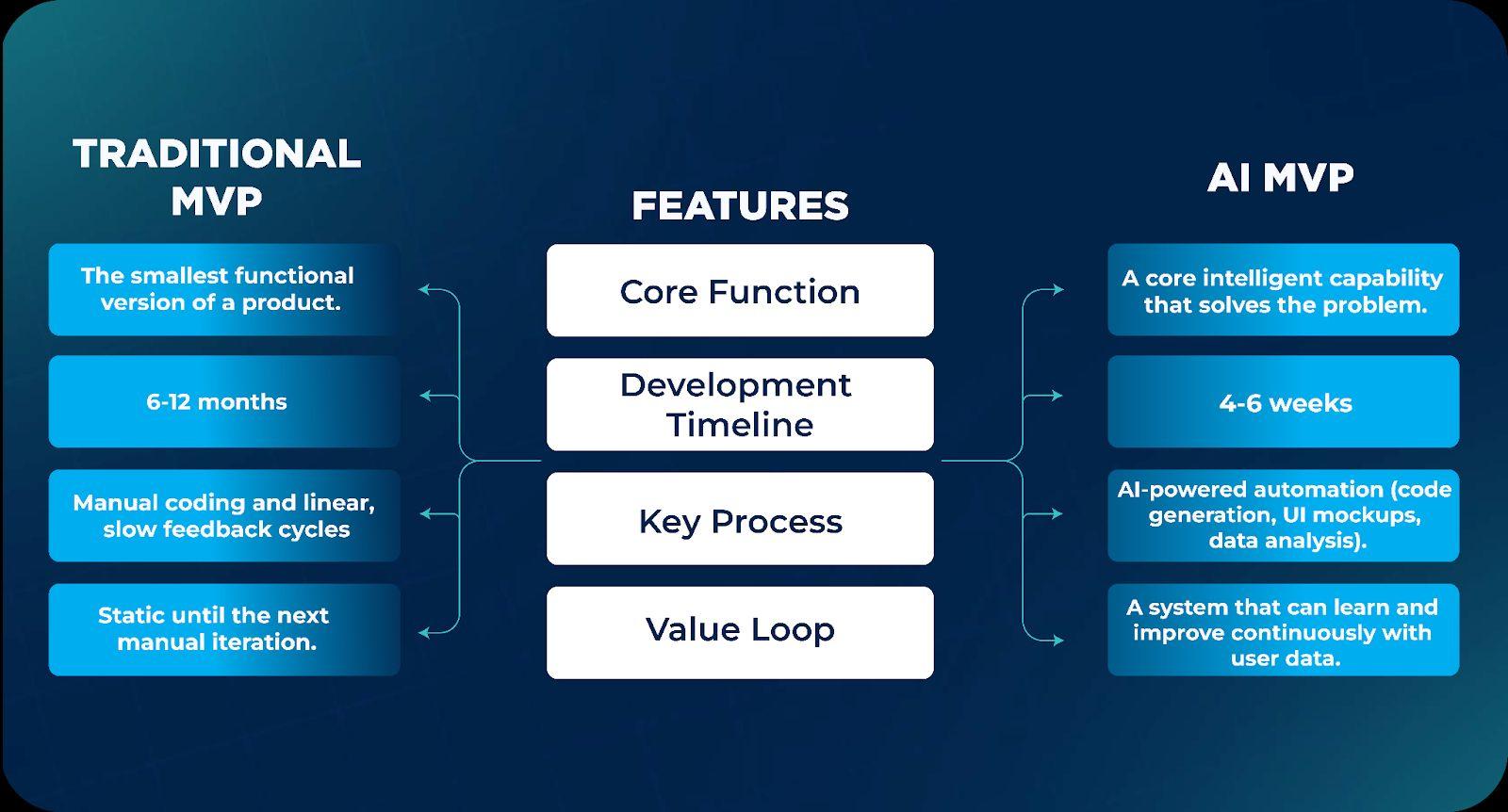
A traditional Minimum Viable Product (MVP) is the leanest version of a product that solves a real problem for a specific user group. It is designed to test a core assumption and maximize learning while minimizing development time and cost.
Historically, this process of manual coding, feedback gathering, and iteration often took 6 to 12 months to complete.
What is an AI MVP?
An AI MVP goes a step further by placing intelligence at its core. It isn't just a static set of features but a system designed to deliver value through an intelligent capability.
This intelligence can take various forms, including predictive analytics, personalization, natural-language interaction, automation, or recommendation systems. An AI MVP allows your startup to test not just a feature, but an intelligent experience.
Key Differentiators
The differences between these two approaches highlight a strategic evolution in product development.
2. The main concern starts with why your startup needs an AI MVP
Building an AI MVP is no longer a novelty but a critical competitive advantage. It empowers your startup to launch faster and fundamentally de-risk your venture in a crowded marketplace.
1. Unprecedented Speed and Rapid Validation: The most significant advantage of an AI MVP is speed. AI tools automate and accelerate every stage of the development lifecycle, from coding and design to feedback analysis. You can now build and test core product ideas in a matter of weeks, not months.
2. Significant Cost Efficiency: AI dramatically reduces development costs by automating repetitive and time-consuming tasks. AI-powered tools handle boilerplate code, generate design mockups, and analyze data, reducing the need for large specialized teams.
3. A Powerful Competitive Edge: An AI MVP development strengthens your startup’s ability to stand out. AI-driven experiences often feel more valuable, intelligent, and personalized to the end-user, creating a stronger initial product-market fit.
According to research from McKinsey & Company, generative AI is projected to add $2.6 trillion to $4.4 trillion in annual economic value, highlighting the immense scale of the opportunity for startups that build with AI from the start.
3. Your Step-by-Step Playbook for Building an AI MVP
This section provides a practical, actionable roadmap for any founder, even those without a technical background. A successful AI MVP development is not built by accident; it follows a disciplined process focused on solving one core problem exceptionally well.
Step 1: Define the Problem and Validate the AI Fit
Before writing a single line of code, start by identifying a clear and specific user pain point. Use AI-powered research tools like Perplexity AI, ChatGPT, or Claude to analyze user needs, search trends, and forum discussions to validate the problem.
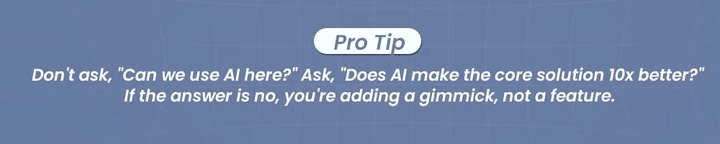
Crucially, you must ensure that AI genuinely adds value to the solution. Ask yourself, will this product be better with personalization, automation, or predictive insights? AI should be a core component that enhances the user experience, not just a novelty.
Step 2: Prioritize the Single-Core Feature
One of the biggest threats to any MVP is feature creep, the tendency to add more and more functionality, which delays launch and complicates the product. Focus on the single intelligent component that delivers the most value to your user.
A proven method for this is the MoSCoW (Must-have, Should-have, Could-have, Won’t-have) framework, which helps you ruthlessly prioritize and commit to building only the absolute essentials for your first version.
Step 3: Choose the Right AI Tools and Technology
The modern AI stack offers a wealth of tools to accelerate development. The key is to choose platforms that match your team's skillset and prioritize integration speed over a long list of features.
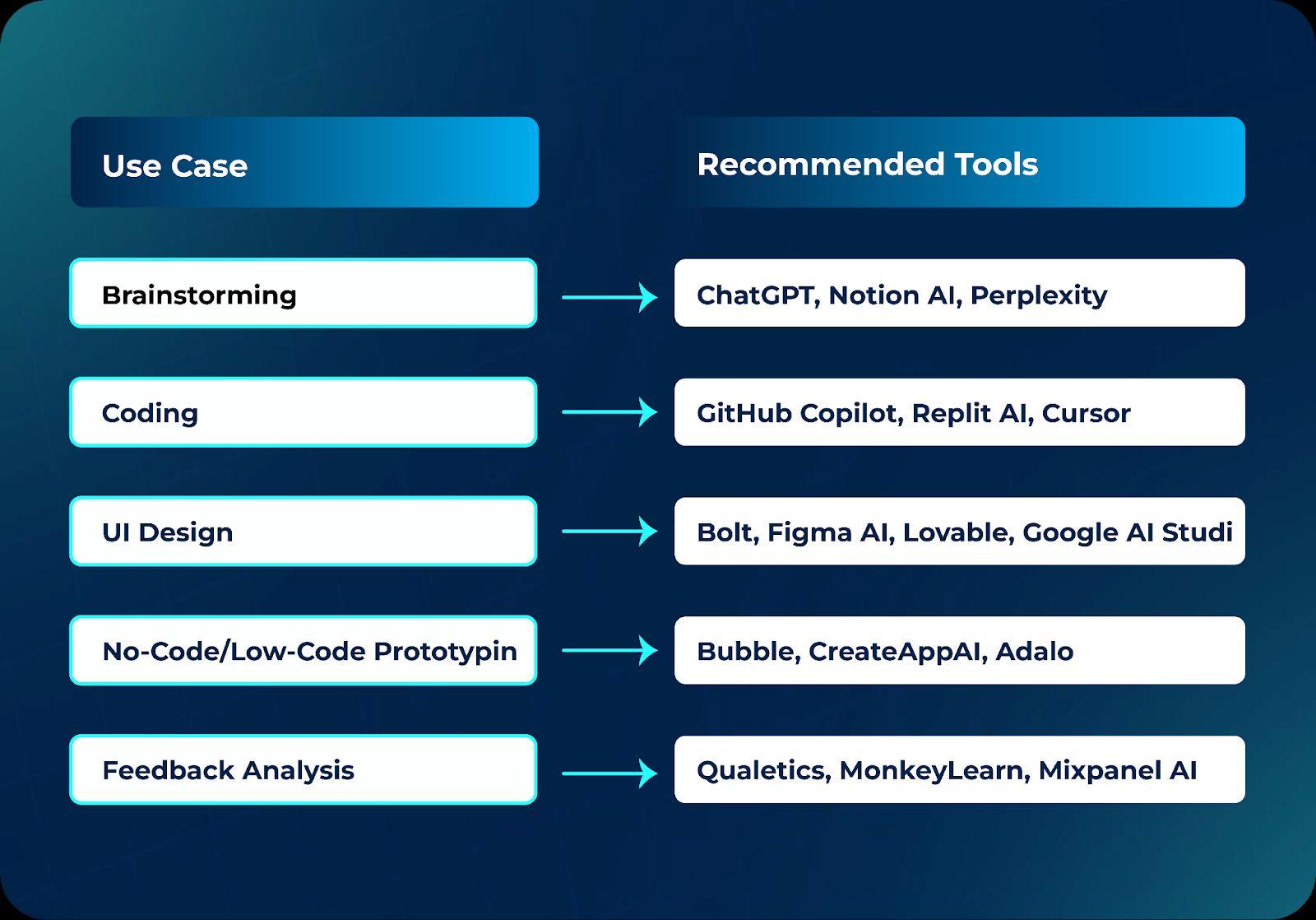
When selecting your core infrastructure, it's also important to choose a scalable foundation that won't box you in later. Technologies like AWS Lambda, Firebase, or Vercel offer modular, serverless architectures that can grow with your product once the idea is validated.
Pro Tip: Your first toolset is for speed, not eternity. Choose no-code/low-code to validate the idea, and ensure your core AI model is accessed via a flexible API.
Step 4: Build a Lean Prototype
The modern, AI-powered workflow makes prototyping faster and more integrated than ever. A common and effective process is as follows:
- Start in ChatGPT to describe your product idea in plain language and ask it to generate a detailed code or prototype plan.
- Use that prompt in an AI-powered coding environment like Cursor or Replit.io to generate and test the actual codebase, refining it through conversational commands.
- Generate a UI design by giving a visual prompt from ChatGPT to a tool like Lovable, which will instantly produce a usable design.
- Integrate the components by uploading the design to GitHub and pulling it directly into your coding environment to connect the front-end with the back-end logic.
Step 5: Prepare for Scale
Once your AI MVP has successfully validated your core assumption, the next steps involve preparing for growth. This includes enhancing model stability, ensuring data compliance and privacy, and reinforcing your infrastructure to handle increased user traffic.
The power of this playbook is proven by startups that are already achieving incredible results, as the next section shows.
4. Now the Real-World AI MVP Successes
Theory is valuable, but real-world examples demonstrate the true power of the AI MVP approach. This section showcases startups that leveraged AI to achieve incredible results with lean teams, tight timelines, and a sharp focus on solving a core problem.
Base44 From Solo Founder to an $80 Million Acquisition
One of the most compelling examples of AI-driven speed and scale is Base44. Its solo founder, Maor Shlomo, built a full-stack AI app builder in just six months using tools like ChatGPT for ideation and Cursor for development.
The platform allowed users to describe an application in natural language, and AI would generate it instantly. Without a large team or external funding, Base44 grew to over 100,000 users, achieved profitability, and was ultimately acquired by Wix for $80 million, within months of its creation.
The key lesson here is to leverage. Shlomo used AI not just to code but to multiply his effectiveness as a solo founder, achieving a scale that would have required a large, funded team just years prior.
While the rewards of this approach are high, it's equally important to be aware of the potential pitfalls along the way.
5. Navigating the Common Challenges and How to Solve Them
While AI offers unmatched speed and potential, it is not a magic bullet. Building a successful AI MVP requires understanding and proactively navigating common challenges that can derail a project. Success lies in using AI wisely and avoiding these costly mistakes.
1. Poor Data Quality
Startups often lack the clean, relevant data needed to train AI models effectively, leading to unreliable or biased outputs.
Strategic Solution: Use synthetic datasets for initial training, leverage public data repositories, and implement a rigorous preprocessing and normalization pipeline for all incoming data.
2. Over-Reliance on AI
Not all tasks should be automated. Human judgment remains crucial for high-level strategy, creative design, and genuine user empathy.
Strategic Solution: Strike a healthy balance between automation and human expertise. Use AI to augment and inform strategic decision-making, not replace it.
3. Scalability Issues
Choosing the wrong architecture early on can create significant technical debt, making it difficult and costly to grow post-launch.
Strategic Solution: Build with modular and serverless technologies, implement flexible APIs from the start, and design your system with future growth in mind.
6. Build Smarter, Not Harder
In 2026, using AI to build your MVP is no longer just a shortcut but a profound strategic advantage. It marks the difference between leading the market and struggling to keep up. AI empowers you to test core assumptions in days instead of months and launch with a clear understanding of what your users truly need.
The goal isn't just to build faster but to build with intelligence from day one, creating a product that not only solves a real problem but also establishes a powerful and defensible foundation for future growth.
Your most common questions—answered!
Got questions? We’re here with every answer you need!!
Explore these quick answers to help you better understand our solutions and how they work.

We focus on delivering customized, industry-specific AI solutions that address real-world challenges. Our team combines years of experience with cutting-edge technology to create impactful results.